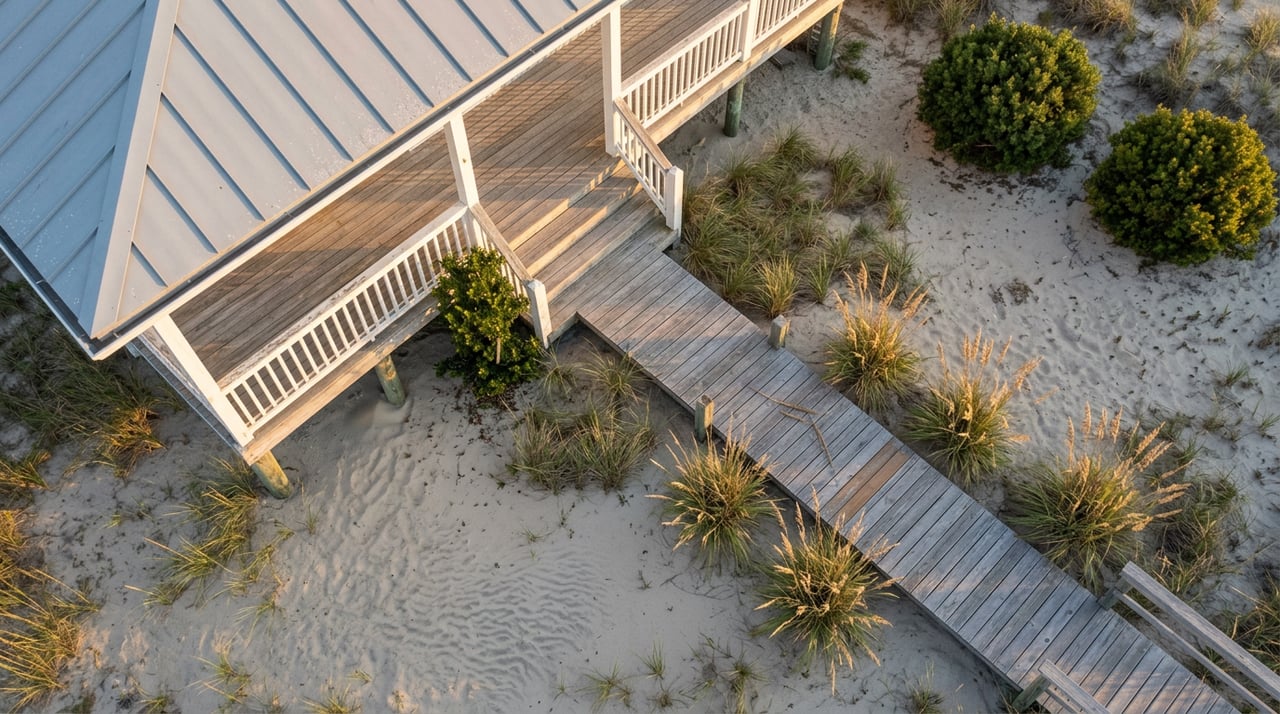
As The Coastland Times reported, in November 2020, a Kill Devil Hills homeowner walked up to his property and found a stop-work notice stapled to one of the pilings. He had hired a contractor to add a deck earlier that year, watched the progress remotely through a doorbell camera because COVID travel restrictions kept him off the island, and paid the final invoice once the work looked done. No one had pulled a permit. When the town's zoning administrator, Donna Elliott, reviewed the file, she found the deck encroached the property's 30-foot front setback line by about two feet, and that a permit would have required building behind that line in the first place.
The Board of Adjustment eventually granted the homeowner a variance, citing a genuine hardship tied to the lot's odd position near the curve of Hayman Park. But the case is worth remembering not because it's rare. It's worth remembering because setback problems in this town don't usually announce themselves. They surface after the deck is built, after the survey is filed, after the offer is already on the table.
The Line Everyone Assumes Is Fixed
Most sellers picture the oceanfront setback as a number: 60 feet, measured from the ocean, end of story. It isn't measured from the ocean. Under North Carolina's Coastal Area Management Act, the oceanfront construction setback is measured landward from the first line of stable and natural vegetation, or from a static reference line where one has been established. The North Carolina Division of Coastal Management sets that baseline using long-term shoreline change rates, not a fixed distance from the water's edge.
That distinction matters because a vegetation line isn't a survey monument. It moves when storms flatten dunes. It moves when a beach nourishment project pushes it seaward. And it drifts, slowly, in the years between nourishment cycles, when nothing dramatic happens at all. A lot that met setback requirements at its last survey can fail them at the next one, without the owner changing anything about the house.
The North Carolina Real Estate Commission has already documented what happens when a buyer assumes otherwise. In one disciplinary case, a buyer submitted an offer on an oceanfront property without confirming setback status first. Only after the inspection and survey were complete did a CAMA representative tell the buyer the lot was non-conforming, meaning the existing structure could not be rebuilt in its current footprint if it sustained damage beyond 50 percent of its value. The Commission's own bulletin on the case notes that lot classification can shift with the location of the vegetation line, and that setback status should be verified with current information, not assumed from an old survey or a neighbor's experience.
Why the Line Depends on a Vote Happening Next Door This Fall
Kill Devil Hills last completed a beach nourishment project on July 22, 2022, restoring 2.58 miles of shoreline from the Kitty Hawk town line to a point 270 feet north of Prospect Avenue. The project before that wrapped up July 27, 2017, covering 2.6 miles along roughly the same stretch. Line those two dates up and the interval is close to five years, which is the maintenance cycle Dare County has generally used for this group of towns.
| Nourishment cycle | Completed | Shoreline restored |
|---|---|---|
| Prior project | July 27, 2017 | 2.6 miles |
| Most recent project | July 22, 2022 | 2.58 miles, Kitty Hawk line to 270 ft north of Prospect Ave |
| Next planned cycle | Not yet approved | Bundled with Duck, Southern Shores, Kitty Hawk |
Kill Devil Hills is now four years past its last renourishment, and the next round isn't locked in. It's tentatively planned for 2027, but it's bundled with Duck, Southern Shores, and Kitty Hawk to share mobilization costs, the same arrangement used in 2022. Southern Shores had been withholding its own approval until its town council could review 2026 beach monitoring data, with a decision expected by this September. If that four-town package slips or shrinks, Kill Devil Hills' beach keeps eroding on the current, unmaintained timeline rather than getting refreshed on schedule.
That decision, made in a neighboring town's council chamber, has a direct line to setback measurements in Kill Devil Hills. A nourished beach holds the first line of stable vegetation further seaward, which gives oceanfront lots more buildable depth landward of the line. A beach running past its normal maintenance window lets that vegetation line keep drifting inland, tightening the margin on lots that were already close to the boundary. None of this shows up on a listing sheet. It shows up when a surveyor flags the line and a lot that looked buildable last year no longer is.
What Non-Conforming Actually Costs You
The 50 percent rule is the part that catches sellers off guard. If a home on a non-conforming lot suffers storm damage, fire damage, or any damage beyond 50 percent of its structure's market value, state and local rules generally require the rebuild to meet current setback and elevation standards, not the standards the original house was built under. On a lot where the vegetation line has crept landward since the house went up, that can mean the replacement structure has to sit further back, shrink, or in some cases can't be placed where the original stood at all.
For a seller, this is a material fact, not a footnote. The Kill Devil Hills Planning and Inspections office maintains the town's Local Permit Officer contact for exactly this kind of verification, and the NCREC's own guidance to consumers states plainly that brokers have a duty to disclose material facts they know or reasonably should know, even when they can't personally calculate an erosion rate. That duty runs both directions. A seller who lists an oceanfront home without confirming current setback status is handing a buyer the same unpleasant surprise the NCREC case buyer got after the ink was already on the offer.
The Board of Adjustment Sees This Every Year
This isn't theoretical for Kill Devil Hills. The town's Board of Adjustment held a public hearing on July 28, 2026, to consider a variance request from Sothel Street LLC for the property at 301 West Sothel Street, citing Chapter 153 zoning setback rules in a Low Density Residential zone. It's a routine agenda item, the kind the board hears most months, and it sits in the same body of ordinance that governed the Hayman Boulevard case six years earlier.
The pattern across both cases is the same. A property owner discovers a setback conflict after work has started, or after a permit application forces the question, rather than before. Getting ahead of the question, before listing or before writing an offer, is the only version of this that works in the buyer's or seller's favor.
Three Questions to Answer Before You List
- Ask the town's Local Permit Officer to flag the current first line of stable vegetation on your lot, rather than relying on a survey from a prior year.
- Get a surveyor to show both the vegetation-line setback and any static development line on the same drawing.
- Have your improvement value checked against the 50 percent rule so you know, before a storm ever hits, whether a major loss would force a smaller or relocated rebuild.
A Few Questions Worth Asking Directly
Does this only apply to oceanfront lots? The CAMA Handbook describes estuarine and soundside lots as falling under a different CAMA category, generally a 75-foot setback from the normal high-water line, but the same principle of a shifting reference line applies there too.
Does beach nourishment automatically fix a non-conforming lot? Not automatically. Nourishment can move the vegetation line seaward, but the classification only changes once the town's Local Permit Officer re-flags the line and it's confirmed on a current survey.
Who do I ask if I'm not sure where my lot stands? Kill Devil Hills Planning and Inspections handles CAMA permit questions locally, and they're the first call before any renovation, rebuild, or listing decision on an oceanfront property.
Setback lines don't send a notice when they move. If you're weighing a sale or a purchase of oceanfront property in Kill Devil Hills this year, get the line checked before you get attached to a number. Lynn Bulman has spent more than two decades walking these lots with buyers and sellers and knows exactly who to call at the town to get a straight answer. Let's Connect before you list or write an offer, not after.
This article is general information, not legal, tax or financial advice. Consult a qualified professional about your situation.
